Way Gaza
Travel through Gaza’s crossings is hard to plan when permits, dates, and required papers live in separate places. People repeat the same steps at each crossing, cannot see a live request status, and fall back on visits and phone calls.
Project details
- Client
- Digital product
- Year
- 2026
- Scope
- UX & UI Design
Project overview
Way Gaza
Stage 01
Problem
Travel through Gaza’s crossings is hard to plan when permits, dates, and required papers live in separate places. People repeat the same steps at each crossing, cannot see a live request status, and fall back on visits and phone calls.
Stage 02
Research
The study mapped the current crossing procedures and spoke with people who travel for study, treatment, work, or family. Competitive context included Mowaten, Nusuk, and UNHCR—to understand official portals and humanitarian tools, not to claim a market win. The recurring gap was informational: submit a request, then wait without knowing why it stalled.
Stage 03
Process
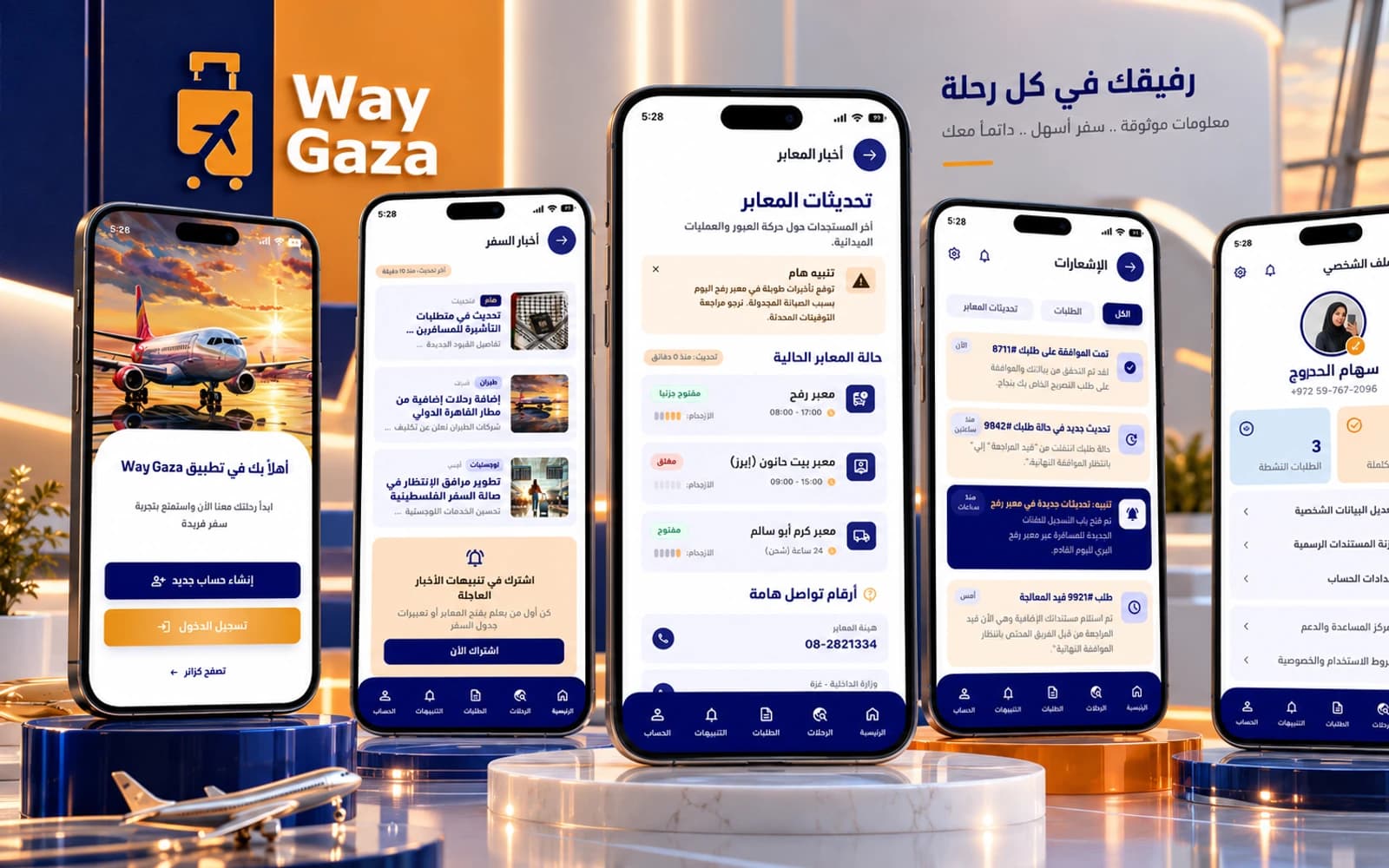
The design is Arabic and mobile-first, with clear request states—in review, approved, rejected, or needs documents—and notifications when something changes. Personal data can be saved for the next request. Copy, hierarchy, and empty states assume low bandwidth and mixed digital confidence.
Stage 04
Solution
Way Gaza is designed as one place to register a crossing request, upload documents, follow status, and read guidance per crossing. Alerts cover status changes, extra papers, and travel dates. Contact with the relevant office is organized inside the product—as a designed service, not as a live government system.
Stage 05
Impact
The experience aims to replace uncertainty and repeat trips with a visible file and fewer blind waits. No operational launch metrics are claimed.
Your next project
Need a clearer experience for your product?
Let’s define the problem, understand the users, and build the next step with confidence.